The U.S. Constitution does not grant an explicit “right to vote.” Instead, it assumes voting exists and regulates who decides voter qualifications. For elections to Congress, the Constitution ties federal voter qualifications to those used for each state’s own legislature.
Some assume Congress can simply legislate citizenship requirements for federal elections. Supreme Court precedent strongly suggests otherwise.
History reinforces this constitutional reading. At various points in American history, many states allowed non-citizens to vote, including in federal elections.
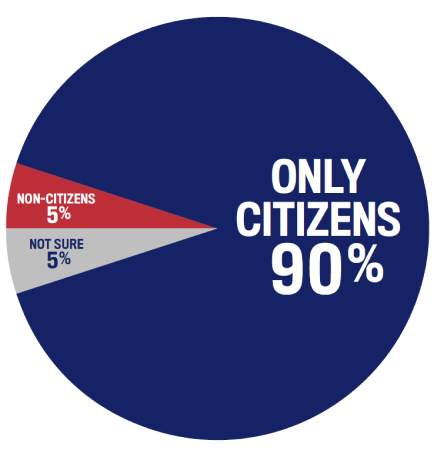
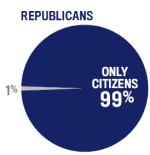
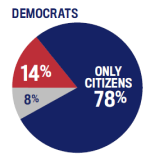
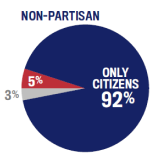
Polling Question:
Do you believe that only U.S. citizens should be able to vote in elections for Congress and the President? Or do you believe that non-citizens should also have the right to vote in these national elections?
Survey conducted July 15–17, 2025. 1,011 likely voters participated in the survey. Survey weighted to match national turnout demographics. Margin of Error is ±3% with a 95% level of confidence. Totals do not always equal 100% due to rounding.
You probably think only U.S. Citizens can vote in federal elections. The law never explicitly says that. It’s time to make a change.
Common Misconceptions – Congresswoman Rosa DeLauro (D) CT-3
Common Misconceptions – Congressman Jerry Nadler (D) NY-12
Common Misconceptions – Congressman Hakeem Jeffries (D) NY-8
Common Misconceptions – The Media (John Dickerson, CBS News)
Common Misconceptions – Congressman Jamie Raskin (D) MD-8
Under the current Constitution, citizen-only voting in federal elections is not guaranteed. States retain broad authority over voter qualifications, Congress lacks clear power to impose citizenship requirements, and existing federal statutes rest on uncertain constitutional foundations.
History shows that non-citizen voting has occurred before—and could occur again—through state action alone. For those who believe that voting in federal elections should be reserved exclusively to U.S. citizens, the legal answer is clear: only a constitutional amendment provides certainty, durability, and legitimacy.
Given the constitutional structure, only an amendment can:
Without an amendment, federal citizenship requirements are still dependent on state law choices and vulnerable federal statutes.
It is widely assumed that only U.S. citizens are legally allowed to vote in federal elections. However, under the current U.S. Constitution, that assumption is not fully correct. The Constitution does not expressly require citizenship as a qualification for voting in federal elections, nor does it give Congress clear authority to impose such a requirement by statute.
Instead, the Constitution leaves voter qualifications to the states. While most states today require U.S. citizenship to vote, history and constitutional structure show that states can choose otherwise. Congress has attempted to prohibit non-citizen voting through federal law, but that statute rests on uncertain constitutional ground and could be repealed or invalidated.
As a result, the only legally durable way to guarantee that only U.S. citizens vote in federal elections is to adopt a constitutional amendment. This white paper explains why that is the case, how such an amendment could be structured, and how it could be ratified.
The Constitution Does Not Create a Right to Vote
The U.S. Constitution does not grant an explicit “right to vote.” Instead, it assumes voting exists and regulates who decides voter qualifications. For elections to Congress, the Constitution ties federal voter qualifications to those used for each state’s own legislature. This means:
There is no constitutional requirement that those voters be U.S. citizens. Presidential elections are handled similarly. States decide how presidential electors are chosen, with Congress having only limited authority over timing—not voter eligibility.
The Existing Federal Ban Is Constitutionally Vulnerable
In 1996, Congress enacted a statute that criminalizes non-citizen voting in federal elections. While still on the books, this law has never been tested in court on the question of whether Congress had constitutional authority to pass it.
The statute does not clearly rest on Congress’s election powers. Instead, it appears to rely indirectly on Congress’s immigration authority. That connection is weak. Regulating immigration and regulating voting qualifications are distinct constitutional domains. Courts would likely view voter qualifications as belonging to the states unless the Constitution itself says otherwise
Why an Amendment Is Necessary
Given the constitutional structure, only an amendment can:
Without an amendment, federal citizenship requirements are still dependent on state law choices and vulnerable federal statutes.
No. Justice Scalia wrote in the Opinion for the Supreme Court Case Arizona v Inter Tribal Council of Arizona Inc. “Arizona is correct that the Elections Clause empowers Congress to regulate how federal elections are held, but not who may vote in them,” and “It is difficult to see how words could be clearer in stating what Congress can control and what it cannot control. Surely nothing in these provisions lends itself to the view that voting qualifications in federal elections are to be set by Congress.”
You can find the entire Supreme Court opinion here, at https://supreme.justia.com/cases/federal/us/570/1/.

Read the exact language of the proposed amendment as it would appear in the Constitution.
Clear, direct text designed to define federal voting eligibility without ambiguity.
Examine the constitutional provisions that govern voting today.
See the language that shapes federal election eligibility as it stands.
In-depth analysis grounded in constitutional law and electoral policy.
Understand the present framework, potential vulnerabilities, and the practical impact of reform.
The U.S. Constitution does not grant an explicit “right to vote.” Instead, it assumes voting exists and regulates who decides voter qualifications. For elections to Congress, the Constitution ties federal voter qualifications to those used for each state’s own legislature. There is no constitutional requirement that those voters be U.S. citizens. Presidential elections are handled similarly. States decide how presidential electors are chosen, with Congress having only limited authority over timing—not voter eligibility.
Some assume Congress can simply legislate citizenship requirements for federal elections. Supreme Court precedent strongly suggests otherwise. The Constitution gives Congress authority over the “time, place, and manner” of federal elections, but courts have consistently distinguished how elections are conducted from who is qualified to vote. Voter qualifications are treated as a separate, substantive issue reserved to the states.
The Supreme Court’s modern cases—most notably Arizona v. Inter Tribal Council of Arizona— reflect broad agreement among justices that Congress cannot use its election-administration powers to dictate voter qualifications.
History reinforces this constitutional reading. At various points in American history, many states allowed non-citizens to vote, including in federal elections. This practice existed:
States such as Wisconsin, Ohio, Maryland, and others extended voting rights to non-citizens, sometimes including those who merely declared an intention to become citizens. These practices ended due to political changes—not constitutional prohibitions.
This historical record demonstrates that non-citizen voting has long been viewed as a state policy choice, not a constitutional violation…